Your Rankings Are Fine. Your Traffic Is Down. Here's What's Actually Happening in Search Right Now.
Something Weird Happened to a Lot of Websites in the Last Eighteen Months
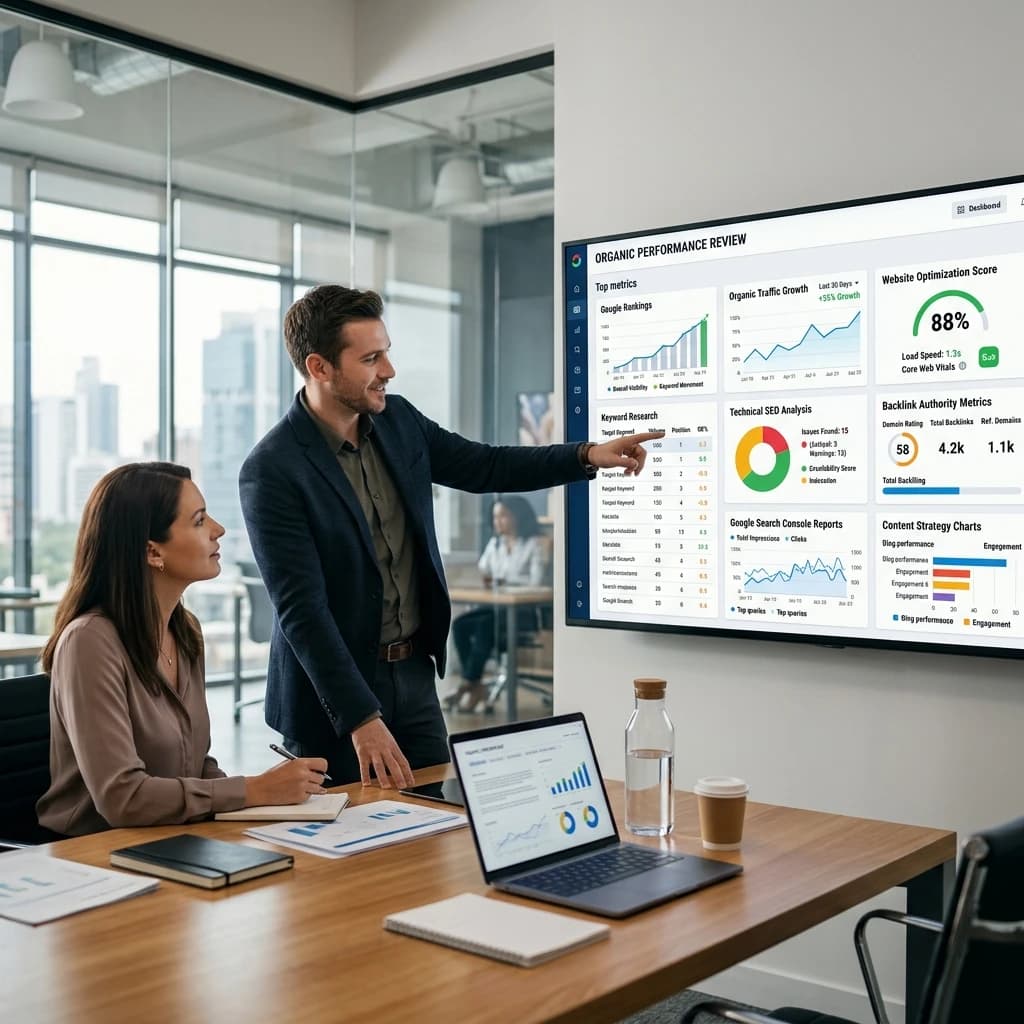
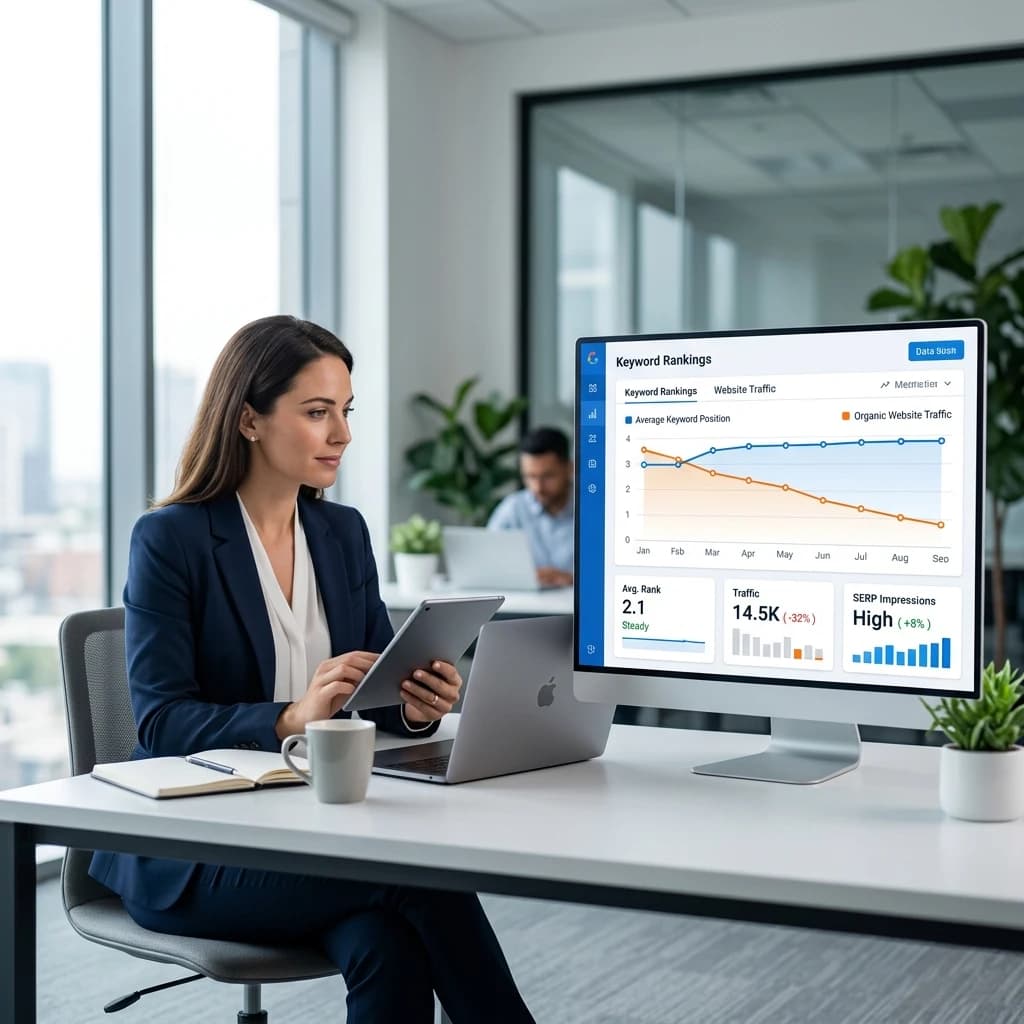
The conversation started showing up in almost every strategy call we had with new clients sometime in early 2025, and it has not stopped. A business owner pulls up their analytics and shows us a chart that should be alarming but somehow is not immediately alarming, because the line is not crashing — it is just quietly, persistently going in the wrong direction. Traffic is down eight percent. Twelve percent. In some cases, twenty percent. And the frustrating part is that when they check their rankings, the rankings are fine. Sometimes better than ever. Page one for the same keywords they have always targeted, with nothing visibly broken.
The explanation for that gap — between rankings holding and traffic falling — is zero-click search, and it is the single most consequential shift happening in digital marketing right now for US businesses. Not AI content tools. Not influencer marketing. Not whatever the latest platform is testing. The structural change in how Google itself is delivering information to searchers is quietly eating into the traffic that thousands of American businesses built their marketing strategies around, and most of them do not have a clean name for what is happening.
This guide is the clean explanation. And more importantly, it is the honest assessment of what businesses should actually do differently right now — not the "SEO is dead, pivot to AI citations" panic version, and not the "nothing to see here" reassurance version either. Both of those are wrong.
What Zero-Click Search Actually Is (And Why It Matters More Than You Probably Think)
The term is straightforward: a zero-click search is any Google search that ends on the results page itself without the user clicking through to any website. The searcher got what they needed from Google's results page — an AI summary, a featured snippet, a Knowledge Panel, a map listing, a direct answer box — and left without visiting a single site.
This is not new. Google has been building toward this for years, quietly, through featured snippets, Knowledge Panels, and local packs. What changed the math dramatically is Google AI Overviews, which launched broadly in the US in May 2024 and has been expanding aggressively since. AI Overviews now appear in roughly 58 percent of tracked queries according to BrightEdge's 2026 data, and the numbers on what they do to click behavior are genuinely jarring once you read them clearly.
According to SparkToro's 2026 analysis using Similarweb clickstream data from January through April of this year, 68 percent of Google searches in the US now end without a click to any website. That is up from 60.45 percent in 2024 — a 7.5 percentage point jump in two years, which is one of the fastest accelerations of the zero-click trend ever measured. Pew Research's study tracking real behavioral data across 68,879 actual Google searches found that when an AI Overview appears, 26 percent of users end their browsing session entirely — not just skip the click, but close the browser. Semrush found that 93 percent of searches conducted specifically in Google's new AI Mode end without a click to any external website.
Let those numbers sit for a moment, because the implications are not subtle. For a business that built its marketing strategy around organic search traffic — one that invested in content, SEO, and rankings on the assumption that a page-one result would translate to visits — these numbers represent a fundamental change in the return on that investment, not a temporary algorithm fluctuation.
That said, the panicked version of this story is wrong too. Search traffic did not vanish. Organic SEO is not dead. The relationship between ranking and traffic has changed, and the businesses that understand exactly how it changed will make smarter decisions than the ones treating this as either an existential crisis or nothing to worry about.
The Part Nobody Tells You: The Clicks That Survive Are Worth More
Here is the most counterintuitive finding in all the zero-click research, and it is worth sitting with before moving straight to tactics.
AI Overviews reduce total click volume — that is clearly documented. But BrightEdge's cross-industry study covering 1,200 websites found that organic search visitors who do click through convert at roughly 23 times the rate of traditional organic search visitors. Semrush found a similar pattern: visitors arriving from AI-generated results convert at 4.4 times the rate of standard organic visitors.
The mechanism makes intuitive sense once you think about it. When an AI Overview answers a simple informational query on the results page itself, it filters out the casual browsers. The users who still click through after reading an AI summary are not casually exploring — they want more depth, more verification, more detail about a specific provider or solution. They have already consumed the general answer and are now pursuing the specific. That is a fundamentally higher-intent visitor than someone who clicked because your blue link was at the top of a results page.
This does not make zero-click search good news. Fewer visitors is fewer visitors, and the arithmetic of reduced volume hitting a higher conversion rate does not always net out in your favor — especially if your traffic was already modest. But it does mean the strategic response is not to panic about traffic volume as if it is the only metric that matters. The response is to make sure that your website, your content, and your conversion infrastructure are built to capture the intent of the higher-quality visitors who are still arriving, while simultaneously working to become the brand that gets cited in AI summaries rather than bypassed by them.
Those are two different problems, and they both deserve real attention.
Who Is Getting Hurt the Most Right Now
The damage from zero-click search is not uniform across industries or content types, and understanding where the pressure is concentrated tells you something useful about where to focus your response.
Informational content is taking the hardest hit. Ahrefs data shows that 99.9 percent of informational keywords now trigger a Google AI Overview. If your content strategy was built substantially around top-of-funnel "what is" and "how does" queries — the kind of educational content that historically generated reliable traffic — you are squarely in the highest-impact category. The AI answers those questions directly, on the page, and the click never comes.
Specific sectors are seeing disproportionate exposure. Real estate queries saw 258 percent growth in AI Overview appearance year over year. Restaurant and local hospitality queries saw 273 percent growth. Retail queries saw 206 percent growth. Healthcare queries sit at 43 percent AI Overview prevalence, which is high enough to be materially impactful. For a local service business or a healthcare practice that built its organic strategy around informational and educational content, the exposure here is real and ongoing.
Transactional and commercial queries are holding up better. Google actually pulled back AI Overviews on e-commerce queries specifically because the AI summaries were not converting into purchases — they were cutting out the click without producing the sale. That retrenchment means product-focused businesses have somewhat more protection, at least for now. But the trend for service businesses, local businesses, and anyone whose site is built primarily around informational content is clearly in the direction of more AI Overview coverage, not less.
The businesses that are growing their organic footprint despite all of this have one thing in common: they are not relying exclusively on informational traffic anymore. They are building content that does something an AI summary box cannot replicate — proprietary data, original case studies, detailed product comparisons, and specific expert analysis that requires a human context the AI does not have.
What This Means for Your SEO Strategy Right Now
If you are running a US business with an SEO investment and you want to know what to actually do differently, here is the honest breakdown.
The first thing to do is understand which part of your traffic is being affected. Pull up Google Search Console and compare impressions to clicks for your most important pages. If impressions are holding steady or growing while clicks are falling, you are looking at zero-click behavior — Google is showing your content in its AI summaries and not sending the traffic. If both impressions and clicks are falling, you may have a separate ranking issue that is not zero-click related.
Stop depending on informational content for traffic volume. The informational blog post is not dead, but its job description changed. In 2026, the informational post earns authority, feeds your AI citation presence, and supports your transactional pages through internal linking. Treating it as a primary source of direct traffic is the model that is breaking. Content that earns real clicks today is content built around comparison, evaluation, decision support, and buyer guidance — what Marketer Milk's analysis calls "bottom-of-funnel blogging." The difference between "what is SEO" (almost universally answered by AI on the page now) and "which digital marketing agency is right for my healthcare practice in Texas" (requires a real destination visit to answer) is the difference between a zero-click query and a commercial one.
Build for AI citation, not just ranking. The businesses that are actually winning in the current environment are being cited inside AI Overviews, which drives branded searches and direct visits from users who saw the citation and wanted more. Seer Interactive's data found that brands cited in AI Overviews earn 35 percent more organic clicks and 91 percent more paid clicks than non-cited brands on the same query. Getting cited is now a meaningful marketing objective, not a nice-to-have. Content that earns citation has specific structural characteristics: it answers one clearly-defined question per section, it includes specific statistics with named sources, it attributes claims to credentialed humans rather than the generic "our team," and it maintains factual consistency across every surface where AI systems might encounter the brand.
Structured data is no longer optional. Schema markup — the technical layer that tells Google explicitly what your content is about, what your business does, who your people are, and what your reviews say — directly affects how AI systems parse and represent your content. LocalBusiness schema, FAQ schema, Article schema with author attribution, and Review schema all influence both traditional search features and AI Overview representation. A site without structured data is handing AI systems less clear information than your competitors with it implemented, which shows up in citation frequency.
Build traffic channels that Google does not control. The clearest hedge against zero-click erosion that the 2026 data points to is an audience relationship that does not depend on whether Google decides to answer your content on the results page. Email lists, direct traffic, social media followings, and branded search volume are all assets that deliver visitors regardless of AI Overview expansion. The businesses that are relatively insulated from zero-click traffic loss are the ones where a meaningful share of their traffic was already coming directly, not through search discovery. Building that direct audience has always been good practice; the 2026 environment has made it genuinely urgent for any business that was disproportionately dependent on organic search.
Invest harder in the bottom of the funnel. The clicks that survive zero-click search are commercial-intent clicks, and the pages that convert them are commercial-intent pages — service pages, comparison pages, case studies, pricing guides, and specific "best for your situation" content that requires a real visit to consume properly. Businesses that redirect their content investment from broad informational volume toward specific, high-intent commercial depth are the ones showing organic growth in 2026 despite the structural headwinds.
What Paid Search Has to Do With All of This
There is a data point that does not get nearly enough attention in the zero-click conversation: Google's paid search revenue hit $56.6 billion in Q3 of 2025, its highest quarter ever, and Sundar Pichai attributed the growth specifically to AI features expanding total query volume. Zero-click search is eroding organic clicks. It is not eroding paid clicks. If anything, it is concentrating commercial clicks into the paid results, because those are the results appearing below the AI summaries and above the organic ones.
This has a practical implication for how US businesses think about their marketing mix. A business that has been relying primarily on organic search for lead generation is now operating in a more competitive and less click-friendly environment for organic, which makes the case for a paid search presence more compelling rather than less. Google Ads, run with real intent targeting, captures demand at the same high-intent moment that organic used to capture it more freely — except now, with zero-click behavior concentrating the remaining clicks into paid positions, a well-run paid search campaign may deliver more consistent qualified traffic than the same organic content investment.
This is not an argument to abandon SEO. SEO still compounds over time in ways that paid search does not, and a brand that earns AI citation through strong content authority is building something that paid ads cannot replicate. The argument is that the two channels work better together in 2026 than either does in isolation, and businesses that have been treating organic search as their primary traffic engine may need to rebalance that mix more explicitly than they have in the past.
The Honest Assessment Nobody Wants to Give You
Here is the version of this conversation I have when I sit down with a client who is trying to figure out what all of this actually means for their business.
The businesses that will struggle most in the next two to three years are the ones whose marketing strategies are built primarily on capturing informational search traffic. They have invested in content that answers general questions, and that content is now being answered on the Google results page, by Google, before the visitor ever arrives. That investment is not worthless — it still builds authority, still earns occasional citations, still contributes to the overall credibility of the brand. But as a direct traffic engine, it is materially weaker than it was two years ago and getting weaker.
The businesses that will grow are the ones investing in commercial-intent content that earns real visits because the user needs to go somewhere to complete their task. They are building email lists and direct audiences that Google cannot intercept. They are running paid search campaigns to capture high-intent commercial queries with real tracking behind the spend. And they are structuring their website content clearly enough to be cited in AI summaries, which builds brand awareness at a scale that traditional organic traffic never could have produced for a small or mid-sized business.
None of that is dramatically different from good digital marketing practice. What has changed is the urgency, and the specific places where the most investment is needed.
How GrowLimo Is Helping US Businesses Navigate This
We are not going to sell you on a magic AI citation service or tell you we can guarantee placement in Google's AI Overviews — anyone making that promise is not being straight with you. What we can do is take an honest look at your current digital marketing setup, identify specifically where zero-click behavior is impacting your traffic based on your actual Search Console data, and help you build the kind of multi-channel strategy that generates consistent qualified leads regardless of how Google continues to evolve its results page.
That includes building the commercial-intent content and conversion-focused landing pages that still earn real clicks, implementing the structured data and schema markup that helps AI systems understand your business clearly, running Google Ads campaigns that capture high-intent buyers efficiently, and building the SEO foundation that earns AI citations over time rather than just ranking for queries that no longer convert to visits.
If your traffic has been quietly going in the wrong direction and you want to understand specifically why and what to do about it, we offer a free digital marketing audit with no obligation. A straightforward look at what your data actually shows, where the gaps are, and what a realistic strategy looks like for your specific business.
Get your free audit at growlimo.com/contact
Frequently Asked Questions
What is zero-click search and why does it matter in 2026?
Zero-click search refers to a Google search that ends on the results page itself without the user clicking through to any external website. The searcher gets what they need — from an AI Overview, a featured snippet, a Knowledge Panel, or another on-page feature — and leaves without visiting any site. In 2026, 68 percent of Google searches in the US now end without a click, according to SparkToro's analysis of Similarweb data covering January through April 2026. This matters for businesses because a page-one ranking that used to translate reliably into website visits now frequently does not, which breaks the connection between ranking performance and traffic volume that most digital marketing strategies were built around.
Why is my website traffic dropping even though my rankings are still good?
If your rankings are holding but traffic is declining, zero-click search is the most likely explanation. Google's AI Overviews are appearing in roughly 58 percent of tracked queries in 2026, and when an AI Overview answers a query on the results page, many users never click through to the ranked sites below it. Organic click-through rate falls to 0.61 percent for queries where an AI Overview is present, compared to 1.62 percent for queries without one, according to search data compiled by ALM Corp. The practical check is Google Search Console — if your impressions are stable or growing while your clicks are falling, you are looking at zero-click behavior specifically, rather than a separate ranking problem.
Does zero-click search mean SEO is no longer worth investing in?
No, but it means the return on SEO investment has changed in character rather than disappeared. Informational, top-of-funnel content that answers general questions is now the category most directly affected by AI Overviews, and it can no longer be relied on as a primary direct traffic driver the way it once was. Commercial-intent content, local SEO, brand visibility in AI citations, and technical SEO fundamentals continue to generate real business value. Brands cited in Google AI Overviews earn 35 percent more organic clicks and 91 percent more paid clicks than non-cited brands on the same query according to Seer Interactive's 2025 data, which means earning citation is itself a meaningful marketing objective that SEO foundations support.
What is GEO, and how is it different from traditional SEO?
GEO stands for Generative Engine Optimization — the practice of structuring and positioning your online content and brand presence so that AI-powered platforms like ChatGPT, Perplexity, Google AI Overviews, and Microsoft Copilot include and cite your brand when generating answers. Traditional SEO focuses on earning ranked positions in the blue-link results on a search page. GEO focuses on earning inclusion in the synthesized, conversational answer that now appears above or instead of those links. The two disciplines share foundational elements — structured content, clear expertise signals, authoritative information — but GEO additionally emphasizes cross-platform brand consistency, named expert attribution, original data and statistics, and content structured for machine extraction rather than just keyword matching.
What is AEO, and how does it differ from GEO?
AEO stands for Answer Engine Optimization — the practice of structuring content so that AI answer engines specifically select it as a cited source when generating a direct answer to a question. If GEO is the broader discipline of managing how generative AI platforms represent your brand across all surfaces, AEO is the specific subset focused on the answer-retrieval moment: ensuring your content is the source cited when an AI engine responds to a question your content is positioned to answer. For a US business, AEO in practice means writing content that leads with a direct, factual answer to a specific question, attributes that answer to a credentialed person or documented source, and maintains consistency with how the same facts appear elsewhere online. Both GEO and AEO build on traditional SEO rather than replacing it — strong technical SEO helps AI engines find and trust your content in the first place.
How do I get my business cited in Google AI Overviews?
There is no guaranteed method, and anyone promising placement in AI Overviews should be viewed skeptically. What the available research identifies as correlated with AI citation is: content that directly answers a specific question in the first one to two sentences of a section without preamble; named author attribution with verifiable credentials relevant to the topic; original data, statistics, or expert analysis that AI systems cannot synthesize from elsewhere; consistent factual information across your website, Google Business Profile, and third-party mentions; structured data (schema markup) that makes your content machine-readable; and an established domain authority from genuine backlinks and a history of credible content. Brands with narrow topical depth — covering a specific subject comprehensively rather than many subjects superficially — consistently earn more AI citations than broad general publishers, regardless of domain size.
Should a US business be increasing or cutting its digital marketing budget because of zero-click search?
Cutting budget is rarely the right response, because the competitive landscape for commercial-intent traffic has not softened — if anything, it has concentrated. What zero-click search specifically argues for is a reallocation of marketing investment rather than a reduction: less toward broad informational content aimed at driving traffic volume, more toward commercial-intent content that earns real visits and conversions, more toward Google Ads which captures high-intent commercial queries that organic is losing click share on, more toward local SEO and Google Business Profile which continue to drive direct leads outside of AI Overview coverage, and more toward direct audience building (email lists, branded search volume) that is not dependent on how Google continues to evolve its results page.
How does zero-click search affect local businesses in the US specifically?
Local businesses are in a mixed position. On one hand, real estate and restaurant queries are seeing among the highest rates of AI Overview growth, which affects visibility for local content. On the other hand, Google's local pack and Maps results — which appear separately from AI Overviews and represent a direct path to calls and direction requests — continue to drive substantial local lead volume outside the zero-click problem. For a US local service business, the most important hedge against zero-click traffic loss is a fully optimized Google Business Profile, active review generation, and local SEO that drives map pack visibility, all of which generate leads through a separate path from the organic results being impacted by AI Overviews. Paid search is the other reliable path, since Google Ads appear above AI Overviews and capture commercial-intent clicks at the highest-intent moment in the customer journey.
Zero-click and conversational search trends are scaling globally. Digital teams are already optimizing local directory presence to counter these patterns in markets like Dubai, UAE and across Australia.
Which types of content still earn organic clicks despite zero-click search growth?
The content that still reliably earns organic clicks in 2026 is content that requires a real destination visit to fulfill its purpose. This includes detailed product comparisons and buyer guides (users need to read the full comparison, not a summary); original research and proprietary data (AI systems cannot replicate something only your company has published); case studies and client-specific results (too specific and contextual to summarize usefully); pricing and service information (users who want to contact or buy need to go to the site); and local business pages (users making an appointment or service inquiry need to reach the business directly). The pattern is consistent: content that completes a task or decision the user needs to make, rather than content that answers a general question the AI can handle on the page, is the category that continues converting organic traffic into business outcomes.
GrowLimo is a full-service digital marketing agency helping US businesses grow through SEO, Google Ads, content strategy, and AI-era search optimization. Based in the US, serving clients across Texas, California, and nationwide.
GrowLimo Team
Author & StrategistOur team of digital marketing specialists combines deep industry expertise with data-driven strategies to help businesses grow.
Related Articles
How to Choose the Best SEO Company in California in 2026
PPC Advertising Services: What You're Actually Paying For, and How to Tell If It's Working