PPC Advertising Services: What You're Actually Paying For, and How to Tell If It's Working

Why This Decision Is Harder Than It Should Be
If you have spent any time looking into PPC advertising services, you already know the frustrating part. Every agency website says roughly the same thing. Data-driven. ROI-focused. Certified Google Partner. Transparent reporting. The words blur together fast, and none of them tell you what you are actually buying.
Meanwhile the quotes you get back range from $500 a month to $5,000 a month for what sounds like the same service. One agency wants a flat fee. Another wants a percentage of your ad spend. A third throws around the word "performance-based" without explaining what that actually means for your invoice.
This is the guide I wish more business owners had before they signed their first PPC contract. I have spent the better part of a decade on the agency side of this business, and I want to walk you through what PPC advertising services actually involve, what reasonable pricing looks like in 2026, which platforms make sense for which businesses, and — more importantly — how to tell whether the agency you are paying is doing real work or just logging in once a week to glance at a dashboard.
What "PPC Advertising Services" Actually Covers
Pay-per-click, at simplest, means you pay a platform — Google, Microsoft, Meta, LinkedIn — every time someone clicks your ad. That part is straightforward. What gets murky is everything that has to happen around that click for your money to turn into an actual customer.
A PPC services in Texas or California is not just "running ads." That phrase undersells what real management involves, and it is exactly the kind of vague language that lets low-effort agencies get away with doing very little for a monthly fee.
Real Google Ads management plans covers account structure and campaign architecture, keyword research and ongoing refinement, ad copywriting and creative testing, bid strategy and budget allocation, conversion tracking setup and maintenance, landing page alignment, audience targeting, negative keyword management, and continuous performance analysis that translates into actual changes to the account — not just a report that summarizes what already happened.
Each of those pieces matters. Skip any one of them and the whole campaign suffers in ways that are not always obvious from the surface-level numbers.
The Platforms, and Which One Actually Fits Your Business
Most people think of PPC and immediately think of Google. That instinct is usually right as a starting point, but it is not the whole picture, and treating Google as the only option is one of the more common mistakes I see businesses make before they understand the landscape.
Google Ads remains the strongest starting point for most businesses, particularly local service businesses, because it captures people who are actively searching for a solution right now. Someone typing "emergency plumber near me" has already decided they need a plumber. Google's average cost per click sits somewhere between $4.51 and $5.26 across industries, though this varies enormously — legal and insurance keywords can run well over $50 a click in competitive metro areas, while plenty of local service categories sit comfortably under $5. The tradeoff for that intent is competition. You are bidding against every other business chasing the same buyer. To make this work, businesses must focus on maximizing ROI and leads from search traffic. If you need a localized strategy, partnering with a specialist for Google Ads management in Texas can help navigate competitive bidding.
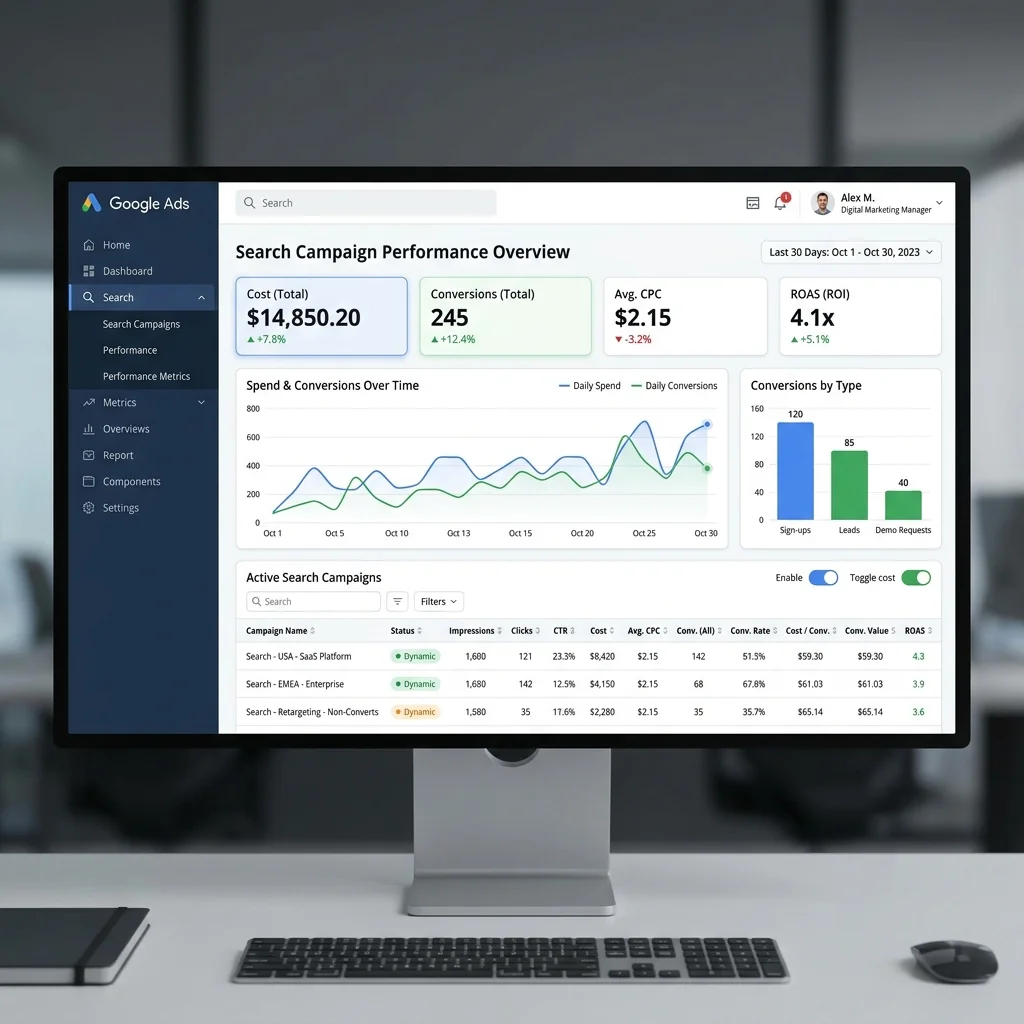
Microsoft Advertising — what most people still call Bing Ads, even though it now runs across Bing, Yahoo, DuckDuckGo, and a handful of partner networks — reaches more than 100 million searchers Google never touches. The audience skews a little older and a little higher income, which tends to work in favor of home services, financial services, and B2B companies. Cost per click is typically 20 to 50 percent lower than Google for the same keywords, simply because fewer advertisers bother showing up here. If you are running Google Ads and have never imported those same campaigns into Microsoft, you are leaving a meaningful amount of low-competition traffic untouched. Importing campaigns is a great way to see how PPC advertising drives instant leads across secondary networks.
Meta Ads — Facebook and Instagram — works differently than search. Nobody is searching for your service on Instagram. What Meta does well is create demand rather than capture it, which makes it strong for businesses with a visual product, a compelling before-and-after story, or a brand that benefits from being seen repeatedly before someone decides to act. It is also one of the more efficient retargeting channels available, bringing back people who visited your site but did not convert. Average cost per click is considerably lower than Google's, often under a dollar, but the intent behind that click is weaker. For a deeper dive into the differences between search and social, read our comparison on Facebook Ads vs Google Ads. To scale these platforms effectively, you may need a dedicated Meta Ads agency to build custom audience structures.

LinkedIn Ads is the most expensive platform per click by a wide margin, and for most local service businesses it makes no sense at all. Where it earns its cost is B2B lead generation aimed at specific job titles, industries, or company sizes — the kind of targeting precision no other platform can match. If your customer is a director of operations at a mid-size logistics company, LinkedIn can put your ad directly in front of that exact person. If your customer is a homeowner who needs their roof fixed, LinkedIn is the wrong tool entirely.
The honest answer to "which platform should I use" is almost never just one. The businesses getting the best results in 2026 are running Google Ads for high-intent capture, layering in Microsoft for the same intent at a lower cost, and using Meta for retargeting and broader awareness — each platform doing the job it is actually good at rather than asking one channel to do everything.
What Good PPC Management Actually Looks Like Month to Month
A lot of the confusion around PPC pricing comes from not knowing what ongoing management is supposed to involve after the initial campaign setup. Setup is the easy part. It takes a few days. What you are really paying for is what happens every week after that.
In the first two to four weeks, a properly managed account is in an active testing phase. This means launching with a structured set of tightly themed ad groups rather than one broad catch-all campaign, writing multiple ad variations to see which messaging actually resonates, setting up conversion tracking for clinics and businesses that captures real outcomes — phone calls, form fills, bookings — not just clicks, and building an initial negative keyword list to filter out the obviously irrelevant searches before they waste budget.
From there, ongoing management is a weekly discipline, not a monthly check-in. A campaign that is actually being managed gets the search terms report reviewed every week, with new negative keywords added as irrelevant queries show up. Bids get adjusted based on what is actually converting, not left on autopilot. Underperforming ads get paused and replaced with new variations. Landing pages get tested against each other when conversion rates plateau. Budget gets reallocated toward the campaigns and keywords producing real leads, and pulled back from the ones burning money without results, implementing advanced Google Ads strategies to reduce CPC while scaling lead volume.

This is the difference that separates a $4,000-a-month account that produces consistent leads from one that produces a lot of clicks and not much else. The platform technology is the same either way. What differs is whether a person is actually paying attention to it every week or whether it was set up once and left alone while you get a static report at the end of the month.
What PPC Advertising Services Actually Cost in 2026
There are three pricing structures you will run into, and understanding the tradeoffs of each one will save you a confusing conversation with every agency you talk to.
Flat monthly retainer. You pay a fixed amount regardless of how much you spend on ads. Most flat-fee arrangements for small businesses land somewhere between $500 and $2,500 a month for the management piece alone, separate from what you pay the platforms directly. This model is predictable, and it removes a subtle conflict of interest that comes up in the next model — the agency has no built-in incentive to push your ad spend higher than it needs to be.
Percentage of ad spend. The agency charges somewhere between 10 and 20 percent of whatever you spend on ads that month. If you are spending $5,000 with Google, a 15 percent fee adds $750 to your bill. This model scales naturally as your business grows, which agencies like because their revenue grows alongside your spend. The legitimate concern some business owners raise is the incentive structure: an agency earning a percentage of spend technically benefits from you spending more, whether or not that additional spend is warranted. A reputable agency manages around this honestly. A less reputable one does not.
Hybrid models. A base fee plus a smaller percentage, or a flat fee with a performance bonus tied to specific outcomes. These exist to balance predictability with scalability, and they show up more often with larger accounts.
Across all three models, here is roughly what the market looks like for 2026. Small business PPC management typically runs $1,500 to $5,000 a month in total fees. Mid-size accounts with more complexity — multiple platforms, larger geographic footprints, more aggressive growth targets — land between $5,000 and $15,000 a month. Enterprise programs running across several platforms simultaneously can exceed $25,000 a month, though that is well outside what most small and mid-sized US businesses need. When weighing these costs, many owners compare hiring a PPC agency vs an in-house team to see which model is more efficient.
One distinction that trips up almost everyone the first time they go through this process: the management fee and the ad spend are two completely separate numbers. If an agency quotes you $1,200 a month, ask directly whether that figure includes what you will be paying Google or Meta directly, or whether it is purely their fee on top of a separate media budget you control. I have seen business owners genuinely surprised three months into a contract when they realized their actual monthly cost was double what they thought they signed up for, simply because nobody clarified which number was which.
A reasonable starting ad budget — separate from management fees — is somewhere around $2,000 to $5,000 a month. Below that range, most accounts in competitive industries struggle to generate enough click volume for the platform's bidding algorithms to optimize meaningfully, and you end up paying a management fee on an account too small to produce reliable data.
The Mistake Almost Everyone Makes: Judging PPC by Clicks Instead of Leads
I want to spend a moment on this because it is, in my experience, the single biggest reason businesses walk away from PPC convinced it does not work for their industry — when the real issue was never the platform, it was what they were measuring.
Clicks and impressions feel like progress. They go up, the chart looks good, the monthly report has a green arrow next to it. None of that tells you whether your business made any money.
A campaign can generate hundreds of clicks a month and zero qualified leads if the keywords are too broad, the ad copy attracts the wrong audience, or the landing page fails to convert visitors once they arrive. These are typical PPC mistakes wasting budget that drain marketing budgets without producing results. I have audited accounts spending several thousand dollars a month where the business owner had no idea their ads were ranking for searches like "how does PPC work" or "Google Ads jobs" — searches from people with no intention of hiring anyone, simply because nobody had built out a negative keyword list in the eight months the account had been running.

The metrics that actually matter are cost per lead, broken down by individual campaign and keyword rather than blended across the whole account, conversion rate from click to actual lead, and — for businesses with a defined sales process — cost per acquired customer once those leads are followed up on. If your agency's monthly report leads with impressions and click-through rate and buries or omits lead volume entirely, that is worth asking about directly.
PPC or SEO First? The Question Almost Every Business Asks
This comes up in nearly every conversation I have with a new client, so it is worth addressing directly rather than dancing around it.
PPC and SEO are not competing strategies. They solve different problems on different timelines, and the businesses getting the best overall return are usually running both, even if one gets more budget than the other depending on where the business is.
PPC gets you in front of customers within days. You set a budget, launch a campaign, and by the following week you can be generating phone calls and form submissions. The tradeoff is that the moment you stop paying, the visibility disappears. There is no equity built up — you are renting attention, not owning it. To decide which strategy fits your timeline, check out our breakdown on SEO vs Google Ads. Many organizations find success by combining medical PPC and healthcare SEO for dual-channel visibility.
SEO takes months to show meaningful results — typically three to six months for early movement and six to twelve months for it to compound into a reliable lead source. What you get in exchange for that patience is visibility that does not disappear the moment you stop actively paying for it. A well-ranked page keeps generating traffic and leads long after the work that got it there is finished, especially when using local SEO tactics to capture near-me searches.
For a business that needs leads now and cannot afford to wait six months for SEO to mature, PPC is the obvious starting point. For a business with the patience and budget to invest in both simultaneously, running PPC for immediate volume while SEO builds in the background produces the strongest long-term position — you are never entirely dependent on a channel you do not own, while investing in long-term SEO services in California or establishing local authority with Texas SEO services to rank high on maps.
How to Evaluate Any PPC Agency Before You Sign Anything
A few direct questions will tell you more about an agency's actual competence than any case study on their website. Before hiring a digital marketing agency in California or a Texas digital marketing agency, test them with these questions:
Ask what conversion actions they are tracking, specifically. Not "we track conversions" — ask which actions count as a conversion in your account. If the answer includes page views or time-on-site rather than actual phone calls and form submissions, the account is being optimized toward signals that do not represent real business outcomes.
Ask how often they review the search terms report. This is the report showing exactly what people typed before clicking your ad. An agency reviewing this weekly is actively managing your account. An agency that cannot answer this question with specifics is probably not looking at it at all.
Ask to see an example of a negative keyword list they have built for a client in your industry. This is a small, specific request that quickly reveals whether an agency does granular account work or runs broad, loosely managed campaigns across all their clients.
Ask what happens in month one versus month three. A credible agency can describe a clear testing and optimization arc — what gets built first, what gets refined once data comes in, and roughly when you should expect cost per lead to stabilize. An agency that gives you the exact same vague answer regardless of the question is likely running templated campaigns without real strategic input.
Ask directly whether the quoted price includes ad spend or not. As covered above, this single question prevents the most common source of billing confusion in the entire industry.
What GrowLimo Does With PPC Advertising Services
We manage Google Ads, Microsoft Advertising, and Meta campaigns for US businesses across home services, healthcare, professional services, and local retail. Every account we take on starts with a real audit — not a sales pitch dressed up as one — looking at what is currently working, what is wasting budget, and what a realistic plan looks like given your industry and competition.
We do not push businesses toward a bigger ad budget than they need. We do not bury lead numbers behind impressions and click-through rate in our reporting. Every monthly review we send connects directly back to cost per lead, qualified call volume, and what we are doing differently the following month because of what the data showed us.
We are a Google-certified partner with more than 10 years of experience managing paid search across competitive US markets. We specialize in Google Ads management that connects directly to business revenue, and our clients see an average of 713 percent revenue growth across their digital marketing programs — not because we spend client budgets faster than other agencies, but because we treat every dollar of ad spend as something that has to earn its way back to the business in real leads.
If you want an honest look at what your current PPC account is actually producing, or a clear picture of what a new campaign could realistically generate for your specific market, we offer a free PPC audit with no obligation attached.
Get your free PPC audit at growlimo.com/contact
GrowLimo is a full-service digital marketing agency serving businesses across the United States. Services include PPC advertising, SEO, web design, and conversion optimization.
GrowLimo Team
Author & StrategistOur team of digital marketing specialists combines deep industry expertise with data-driven strategies to help businesses grow.
Related Articles

How to Choose the Best SEO Company in California in 2026

Your Rankings Are Fine. Your Traffic Is Down. Here's What's Actually Happening in Search Right Now.